
Explore the Kingdom’s business landscape, investment opportunities and establishment options.
Saudi Arabia at a glance
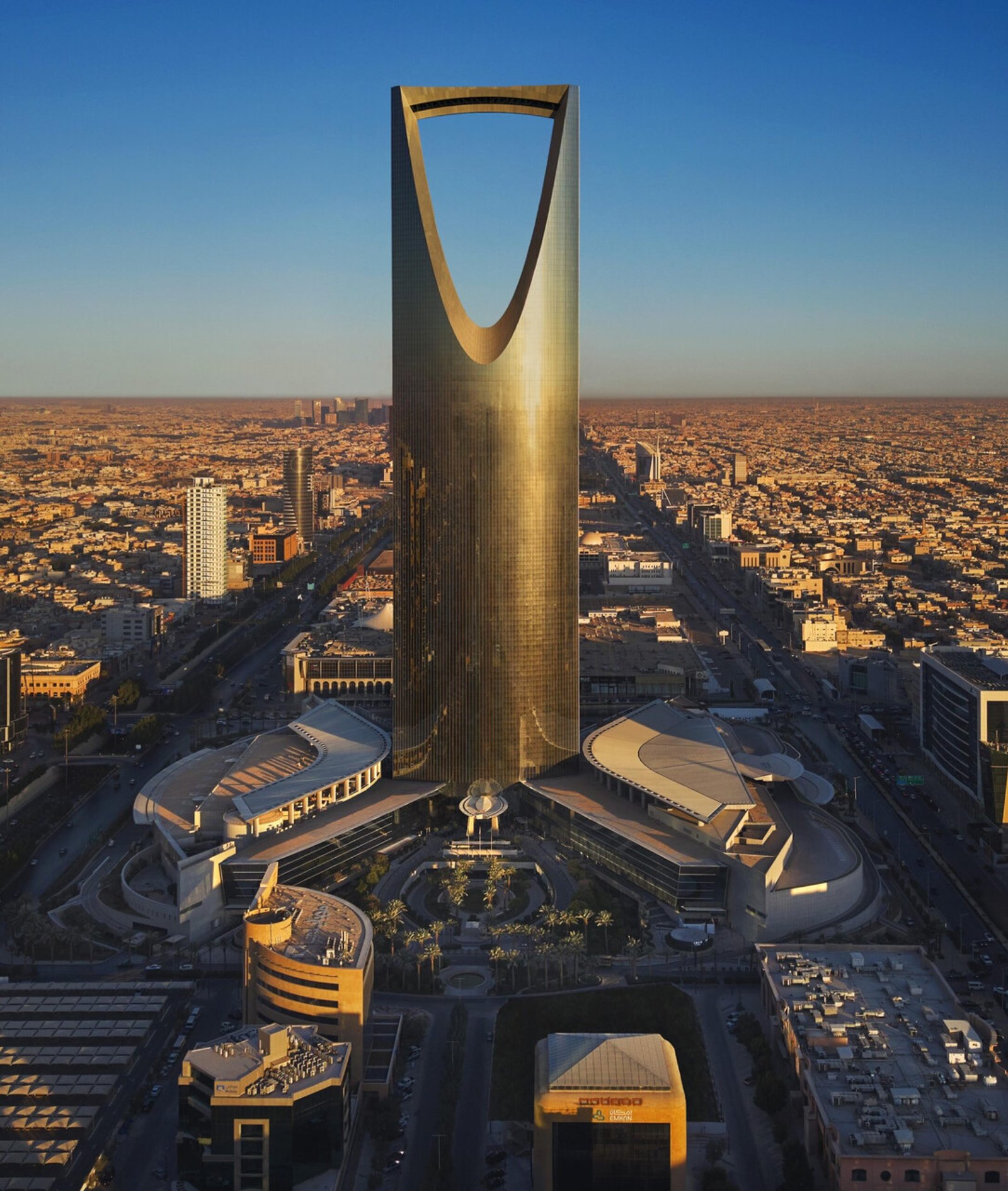
The Kingdom of Saudi Arabia is one of the Gulf Cooperation Council (GCC) members. With a land area of more than two million square kilometers, it is the largest country in the Middle East. It is bordered by the Arabian Gulf, Qatar, and the United Arab Emirates to the east, the Red Sea to the west, Oman and Yemen to the south, Iraq to the northeast, and Jordan to the north.
Arabic is the official language of the country. Islam is the official religion, and the Hijri calendar is the official calendar of Saudi Arabia.
Saudi Arabia is densely populated, exceeding thirty-five million inhabitants in 2025, and represents approximately 61% of the total population of the GCC countries. It also has quite a young population, with more than 28% of Saudis aged 20-34 years and over 13% aged 35-44 years.
The most active cities in the Kingdom are Medina, Riyadh, Jeddah, and Dammam. From a spiritual standpoint, Mecca is the location of the sacred house of God. In addition, it is an important destination for Muslim pilgrims during Hajj and Ramadan. As for Medina, the Prophet Muhammad—the Prophet of Muslims—lived and was buried there.
Because of the country’s vast area, it has notable geographical and climatic diversity. Dominated by an expansive desert in the east, a hot climate prevails throughout most of the year, except during the winter, when the weather is relatively mild. The terrain is entirely different in the southwest portion of Saudi Arabia, where agricultural land and forests extend over vast areas. Rainfall rates are significantly higher, and the temperatures in these areas are moderate compared to the rest of the Kingdom. In contrast, the western mountains stretch along the coast of the Red Sea, forming the Hijaz Mountains, which begin at the Yemeni border and end approximately sixty kilometers before Mecca.
Saudi Arabia is an active member of many international organizations,including but not limited to:
1- United Nations (UN)
2- World Trade Organization (WTO)
3- Group of 20 (G20)
4- States of the Gulf Cooperation Council (GCC)
5- League of Arab States (LAS)
6- Organization of Petroleum Exporting Countries (OPEC)
7- Organization of Islamic Cooperation (OIC)
Vision 2030
and economic development
Since 2016, when King Salman Bin Abdulaziz assumed power, Saudi Arabia adopted a new vision to develop the Kingdom and achieve sustainable development by 2030.
The main pillars of this vision are:
Increasing the local content in the oil and gas sector from 40% to 75%.
Settling 50% of total government military spending in the Kingdom.
Raising the rate of non-oil exports to 50% of the GDP.
Raising the private sector’s contribution to GDP from 40% to 65%.
Elevating Saudi Arabia’s economy to the top 15 in worldwide rankings.
Increasing the proportion of foreign direct investments (FDI) from 3.8% to 5.7%.
Raising the value of the Public Investment Fund’s assets from 600 billion Riyals to 7 trillion Riyals.
Developing the logistics sector to qualify the Kingdom to rank 25th or better globally and number one in the Middle East.
Developing the e-government sector to reach one of the top 5 positions worldwide.
Increasing the capacity of pilgrims from 8 million to 30 million yearly.
Doubling the number of archaeological sites registered with UNESCO.
Adding three Saudi cities to the list of the top 100 cities in the world.
Raising household spending on recreational and cultural services from 2.9% to 6%.
Reducing the unemployment rate from 11.6% to 7%.
Why do business in Saudi Arabia?
There are many reasons why Saudi Arabia makes the perfect destination for your upcoming expansion. Several of the most important are summarized below:
100% Foreign Ownership
Saudi Arabia allows foreign investors to own 100% of their investment in the Kingdom.
Largest Economy in the MENA
Saudi Arabia is one of the largest 20 economies in the world—and the largest in the MENA.
Largest Market Size in the MENA
boasting thirty-five million consumers. That represents about 61% of the total population of the GCC countries, which makes KSA the largest market in the Gulf Cooperation Council (GCC).
Stable Economy
Saudi Arabia is considered one of the most stable economies in the MENA. In 2021, it ranked as follows: (A1) at Moody’s, (A+) at Fitch, and (A) at S&P. This reflects the presence of optimistic expectations about continued economic growth.
Safe Country
According to the World Population Review, Saudi Arabia is one of the safest countries in the MENA, with a crime rate of 25.23 compared to 47.70 in the USA. (link)
1st Nominal GDP in the MENA
The nation ranks 20th worldwide in terms of Nominal GDP and 1st in MENA, according to the World Bank report. (link)
2nd Globally in Oil Reserves
Saudi Arabia ranked 2nd globally in terms of oil reserves, according to the 2021 BP Review. (link)
3rd FDI Recipient in the MENA
In 2019, it ranked as the 3rd country in the Middle East for receiving inflow FDI, following only the UAE and Egypt. (link)
1st globally for Road Connectivity
Saudi Arabia was ranked 1st worldwide for road connectivity by the World Economic Forum. (link)
Soundness of Banks
Saudi Arabia ranked 15th globally in terms of soundness of banks, according to the World Bank report. (link)
Ranked Among the Top 5 Countries in Global Infrastructure Index.
Booming Economy
With Giga Projects like NEOM, Amaala, Qiddiya, Diriyah Gate, Red Sea Project, and Aseer Project, Saudi Arabia will witness a momentum-transformation era that presents unmatched investment opportunities.
Competitive Tax Regime
Saudi Arabia has one of the most competitive tax systems in the MENA region, as it offers:
Corporate income tax at a flat rate of 20%
Value Added Tax (VAT) at a flat rate of 15%
No salary taxes
Extensive double tax treaty network with over 55 countries (link)
Advanced electronic system to register with the tax authority, submit an annual tax return, VAT payment, or issue E-invoices.
Abundance of a Young Workforce
Saudi Arabia enjoys an abundance of a young workforce and has a young population overall. The percentage of the population between 15 and 35 years is approximately 34%.
Affordable Labor
With a median annual income of $30,000, Saudi Arabia provides affordable labor costs for highly educated employees and skilled workers.
High Digital Skills
Saudi Arabia ranked in the top 10 countries globally in terms of its population’s digital skills. (link)
A Nexus Between all GCC Members
KSA is the only country with a direct land route to all other GCC countries, in addition to roads that link it with Jordan, Iraq, and Yemen, which give investors easy access to eight Arabian countries.
Strategic Location
The Kingdom enjoys a strategic location at the crossroads of major western and eastern economies.
Freedom From Natural Disasters
Saudi Arabia enjoys freedom from some of the natural disasters that might plague other countries, like forest fires, hurricanes, volcanoes, earthquakes, or floods.
Expansive Land Area
It is the second-largest country in MENA by land area—approximately 2,150,000 square kilometers.
In addition to the aforementioned points, the Saudi Arabian government has taken many measures to encourage foreign investment in its territory. One of the most significant of these reforms is the Foreign Investment Law (No. M/1) dated April 2000, which included a litany of guarantees and incentives aimed at encouraging foreign investment in Saudi Arabia. Furthermore, in February 2020, the Saudi King issued a royal decree, turning the Saudi Arabia General Investment Authority (SAGIA) into the Ministry of Investment in Saudi Arabia (MISA). This reflects a great interest within the Saudi government in promoting greater foreign investment in the Saudi market.
Investment guarantees for foreign investors
1-The foreign investor has the right to transfer his share of the company’s profits, funds from selling his share in it, or the liquidation surplus abroad. He has the right to dispose of it. He is also entitled to transfer any amount necessary to fulfill his contractual obligations to the project.
2-The foreign investor and his employees shall enjoy legal residency in the Saudi Kingdom throughout the project period.
3-The foreign investor shall receive all benefits, guarantees, and incentives that national projects are provided.
4-The foreign investor’s belongings may not be confiscated in whole or in part, except through a court verdict.
5-It is not permissible to expropriate a foreign investor’s belonging, in whole or in part, except for the public interest, and in return for fair compensation in accordance with regulations and instructions.
6-The foreign investor may own the real estate necessary for the establishment of his project or to house his employees, in accordance with the provisions of non-Saudi real estate ownership.
7-The foreign investor has the freedom to transfer shares between partners and others upon approval of the appropriate authority.
8-The foreign investor has the right to benefit from the industrial loans provided by the Saudi Industrial Development Fund.
9-The foreign investor has the right to take advantage of the benefits arising from double taxation avoidance agreements concluded by the Kingdom.
10The foreign entity has the right to carry forward its losses for the following year, and obtain tax exemption, provided that these losses are deducted when profits are achieved.
Company structures in Saudi Arabia
Establishment options
According to the Executive Regulation of the Saudi Foreign Investment Law, Article No (4) states that foreign investments might take any of the following legal forms:
Limited Liability Company – LLC.
Stock Company.
Foreign Branch.
Professional Company.
Limited Liability Company – LLC
A Limited Liability Company, or LLC, is a company whose capital is made up of the basic shares contributed by shareholders. Its liability extends to include all its assets to cover the company’s obligations, whereas the shareholders’ liability is limited to their shares in the company’s capital. An LLC’s founder might be one or more natural persons or legal entities, with a maximum of 50 partners.
MISA does not ask for minimum capital to set up an LLC. Nevertheless, for specific activities, a minimum capital might be required, such as wholesale and retail trade, transportation, or property financing.
A Limited Liability Company has one or more managers appointed by the shareholders. The company’s manager can be either Saudi or a foreigner. He can be dismissed at any time by a resolution issued by the shareholders.
Joint Stock Company
A Joint Stock Company is a company whose capital is made up of the basic stocks contributed by the stockholders, which are transferable in the stock market.
The Joint Stock Company’s liability extends to include all its assets to cover the company’s obligations, whereas the stockholders’ liability is limited to their shares in the company’s capital. A Joint Stock Company’s founder might be one or more natural persons or legal entities, with no maximum number.
The minimum capital for a Joint Stock Company is SAR 5,000,000 for a one-person Joint Stock Company and SAR 500,000 for other Joint Stock Companies. At least 25% of this capital must be paid during the incorporation process.
According to the Saudi Companies’ Law, the constituent assembly – an assembly consisting of the company’s founders and the stockholders – must appoint a board of directors to manage the company. This board of directors must consist of no less than three and no more than eleven members.
The duration of the first board of directors shouldn’t exceed five years, while the period of each subsequent board of directors mustn’t exceed three years. Nevertheless, the members of the ordinary general assembly may dismiss the board of directors for good reason, as long as this dismissal does not violate the directors’ rights.
Foreign Branch
Foreign companies are allowed to open a branch for their companies in Saudi Arabia, if they have all the documents required by MISA.
Professional Company
Foreign companies wishing to practice professional activities in the Saudi Kingdom, can set up their professional company, provided that having a Saudi partner who have at least 25% of the company shares.

Your questions about business setup in KSA
Which legal form is most appropriate for a foreign company in Saudi Arabia?
The appropriate legal form could be determined based on the number of shareholders and the company’s expected activity. In general, the Limited Liability Company is the optimal choice for the following reasons:
Usually, no minimum capital is required.
It is the fastest legal form to set up. Often, the formation process doesn’t take longer than 60 business days.
There is no need to hold a constituent assembly to appoint the board of directors.
The LLC is simpler in terms of amending the AoA and appointing or dismissing managers.
The LLC is simpler in terms of financial auditing.
Can foreigners set up a 100% foreign company in Saudi Arabia without any local partners?
Foreign Investment Law (No. 1/M) dated 1421 Hijri allows foreigners to own 100% of their investment in the Kingdom. However, there are specific activities that do require a minimum local partnership. For further details, please review the materials found [here].
What laws govern the corporate sector in Saudi Arabia?
Two main laws govern and organize the corporate sector in Saudi Arabia:
Corporate Law (No. M/132), dated 01.12.1443 Hijri, corresponding to 30/06/2022, and its executive regulations.
Must I be present in the country to set up the company?
No. Whether you are the shareholder or the manager, your presence is not required during the incorporation process if you have an agent in Saudi Arabia.
Who is allowed to submit the incorporation documents to MISA?
Only a Saudi agent -regardless of his profession- can submit the incorporation documents to MISA; otherwise, the application will be rejected.
What does it require to set up a company in Saudi Arabia?
DOCUMENTS:
Legalized Power of Attorney (PoA).
Legalized Shareholder Resolution, including the decision to set up a company in KSA.
Copy of translated Commercial Register (CR) and financial statements of the shareholder/s for the last year.
Copy of translated Passport of the proposed manager/s.
INFORMATION:
Four proposed trade names.
Declaration of the amount of company capital.
Company address.
Company activity.
Company’s proposed duration.
TIME:
The time required for incorporating a company in Saudi Arabia varies significantly based on many factors, including:
Availability of required documents
The time/season of document submission: The process may take longer if the documents are being submitted during Ramadan, Eid Al Adha, or Eid Al Fitr
The timeline the investor follows to pay investment license fees, as the incorporation process can’t be completed without obtaining this license.
If the required documents are ready, and there are no official holidays during the application period, the standard time for obtaining your company’s documents is 50-60 business days, after which you will receive the following:
Investment License (MISA License)
Notarized Articles of Association (AoA)
Commercial Register (CR)
Zakat Certificate (Tax ID)
FEES:
The official incorporation fees consist of:
Investment License – around $3200
Notarizing the AoA – around $350
Issuance of the CR – around $1200
Bank Account: to be determined based on the company’s activities and the legal type.
Professional Fees: based on the engagement letter
I want to use the trade name of the mother company for my subsidiary in Saudi Arabia. How can I ensure that it is not already in use in the country?
The Ministry of Investment in Saudi Arabia provides a trade name reservation service with no need to go through the incorporation process. Hence, you can check the availability of your trade name before commencing the company formation.
Can the company’s documents (CR, AoA, Tax ID, etc.) be issued in English or any other language?
A bilingual AoA can be issued, and the Ministry of Commerce will provide an English version of the CR upon request.
Is Saudi Arabia a signatory to the Apostille Convention (Hague Treaty Convention 12)?
Yes, Saudi Arabia is a signatory to the Apostille Convention (Hague Treaty Convention 12). Therefore, any documents submitted to the Saudi authorities do not need to be legalized to be usable in KSA.
What activities are foreign investors prevented from pursuing in Saudi Arabia (Negative List)?
Industrial Sector:
Oil exploration, drilling, and production, except services related to the mining sector listed at CPC 5115 + 883 in International Industrial Classification Codes.
Service Sector:
Catering to military sectors.
Security and detective services.
Real estate investment in Makkah and Medina.
Tourist orientation and guidance services related to Hajj.
Recruitment services.
Commission agents internationally classified at CPC 621.
Fishing/hunting marine life and resources.
What percentage of foreign employees is a foreign company allowed to hire in Saudi Arabia?
You can assign a foreign manager/s to your company, eliminating the need to calculate the ‘Saudization’ ratio. As for foreign employees, this depends on the required profession, as well as the size and the activity of your firm. Some jobs are entirely off-limits for foreigners, whereas others are limited to a specific percentage of the company’s workforce.
It’s worth mentioning that the Ministry of Human Resources and Social Development (HRSD) offers an electronic calculator, allowing any firm to find out whether they are in the green segment and can hire more foreigners or if they have exceeded their maximum limit and need to adjust their segment. You can access this service using the link [here]
Must I obtain a work permit for the company’s manager or foreign employees?
The manager whose name is mentioned on the CR must obtain a visa to be able to run the business. Without a visa, he can’t sign any document on behalf of the company.
Employees also need to obtain visas if they have to stay continually in the Kingdom. However, other employees perform work that doesn’t require them to stay in the Kingdom for months at a time and who don’t deal with any Saudi authorities or ministries directly. For them, it’s more feasible to provide them with an e-visa, which allows foreigners to stay in the Kingdom for up to 30 days.
Is there a Saudi Law pertaining to Intellectual Property? Has Saudi Arabia signed any international conventions concerning Intellectual Property?
Intellectual Property rights in Saudi Arabia are governed and organized by The Saudi Authority for Intellectual Property. They manage this sector by applying the following laws:
Copyright Protection Law, issued by royal decree No. M/41, dated 2nd Ragab 1424 Hijri
The GCC Trademark Law, issued by royal decree No. M/51, dated 26.07.1435 Hijri
The GCC Patent Law, issued by royal decree No. M/28, dated 10.06.1422 Hijri
Law of Patent and Integrated Circuit Layout Designs, Industrial Models, and Plant Varieties, issued by royal decree No. M/27, dated 29.05.1425 Hijri, amended by Cabinet’s decision No. 536, dated 19.10.1439 Hijri
Saudi Arabia is also a signatory to, among others, the following international conventions concerning IP:
Berne Convention
Paris Convention
Patent Co-operation Treaty
WIPO Convention
What are the key issues that I need to consider when establishing a company in Saudi Arabia?
Government Relations Officer (GRO)
Once you have finalized the incorporation process, you need to hire a qualified Saudi GRO. This is not an option; it’s a necessity according to the latest regulations issued by the Ministry of Human Resources in KSA. Without a GRO, you won’t be able to complete the incorporation process, open a Social Insurance file, obtain a municipality license, or activate your company account at the Chamber of Commerce. You will also need a GRO to facilitate the regular renewals of your company.
E-Lease Agreement for your office:
Ensure that the broker you are dealing with will provide you with an E-Lease Agreement. Otherwise, you won’t be able to obtain your municipality license.
Bank Account:
Opening a bank account for your business in Saudi Arabia is essential. All governmental payments are now made electronically and should be paid at specific times through a local payment platform called SADAD. This platform is accessible only to those with Saudi bank accounts.
Saudization Ratio:
Tracking the Saudization ratio at your company is a crucial matter. The Saudi government applies severe penalties to firms that don’t comply with the Saudization ratio rules. Also, before hiring any foreign employees, you should ensure that the profession you are hiring for is not among the jobs that have been restricted to Saudi citizens only.
Is Saudi Arabia a signatory to any Double Taxation treaties?
Saudi Arabia has signed Double Taxation Avoidance Agreements (DTA) with multiple countries. For further updated details, please check the (link)
Double Taxation Agreements (DTA) between Saudi Arabia and other countries
| Effective Date | Country | No |
| 1983 | France | 1 |
| 2006 | India | 2 |
| 2006 | China | 3 |
| 2006 | Pakistan | 4 |
| 2007 | Malaysia | 5 |
| 2007 | UK | 6 |
| 2007 | Austria | 7 |
| 2008 | Korea | 8 |
| 2008 | South Africa | 9 |
| 2008 | Spain | 10 |
| 2009 | Turkey | 11 |
| 2009 | Italy | 12 |
| 2010 | Netherlands | 13 |
| 2010 | Syria | 14 |
| 2010 | Greece | 15 |
| 2010 | Uzbekistan | 16 |
| 2010 | Belarus | 17 |
| 2010 | Russia | 18 |
| 2011 | Vietnam | 19 |
| 2011 | Singapore | 20 |
| 2011 | Bangladesh | 21 |
| 2011 | Japan | 22 |
| 2012 | Ireland | 23 |
| 2012 | Poland | 24 |
| 2012 | Romania | 25 |
| 2012 | Malta | 26 |
| 2012 | Ukraine | 27 |
| 2013 | Tunisia | 28 |
| 2013 | Czech | 29 |
| 2014 | Luxembourg | 30 |
| 2015 | Hungary | 31 |
| 2015 | Azerbaijan | 32 |
| 2015 | Tajikistan | 33 |
| 2015 | Kyrgyzstan | 34 |
| 2016 | Kazakhstan | 35 |
| 2016 | Algeria | 36 |
| 2016 | Ethiopia | 37 |
| 2016 | Venezuela | 38 |
| 2016 | Sweden | 39 |
| 2016 | Republic of North Macedonia | 40 |
| 2016 | Portugal | 41 |
| 2017 | Jordan | 42 |
| 2017 | Egypt | 43 |
| 2017 | Turkmenistan | 44 |
| 2018 | Hong Kong | 45 |
| 2018 | Mexico | 46 |
| 2019 | Cyprus | 47 |
| 2019 | Bulgaria | 48 |
| 2019 | Georgia | 49 |
| 2019 | UAE | 50 |
| 2019 | Albania | 51 |
| 2021 | Kosovo | 52 |
| 2021 | Gabon | 53 |
| 2021 | Switzerland | 54 |
| 2021 | Mauritania | 55 |
Note: this table was published before signing the new global tax agreement in October 2021. It will be updated once we analyze the impact of this agreement on the above-mentioned treatments.
Plan your expansion into Saudi Arabia
Tell us about your proposed activity and the support you need to establish and operate in the Kingdom.
Cairo
Nile City Towers, Corniche El Nile
Cairo 11624, Egypt
+20 128 196 6271
Riyadh
Olaya St., Al Olaya Tower
Riyadh 11523, Saudi Arabia